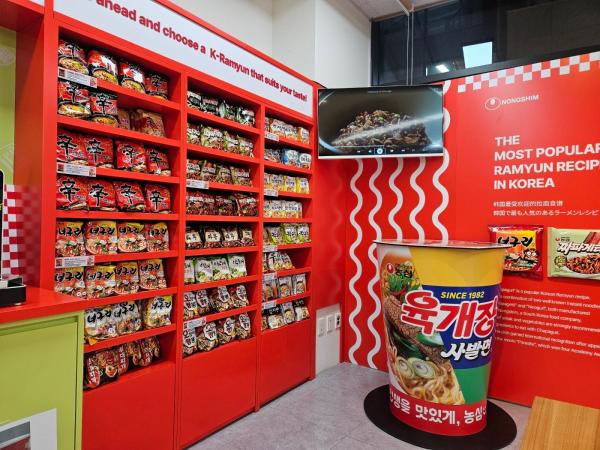
K-Food has officially gone mainstream in Singapore — and the clear frontrunner is K-ramyun.
In the global gateway city of Singapore, Korean brands are rapidly embedding themselves into daily life. From airport concessions and duty-free stores to premium grocery chains and convenience stores, K-food is no longer a niche import — it’s a lifestyle category.
And leading the charge? Korean instant noodles.
K-Ramyun: The Unexpected Winner in a Tropical Food Paradise
Singapore is famous for its hawker culture and dining scene. Naturally, many expected limited demand for packaged Korean food.
But the reality is different.
K-ramyun shelves are positioned alongside popular snack categories — and often occupy top-tier shelf space, even when placed next to local brands.
At convenience stores like 7‑Eleven on Orchard Road, Korean ramyun is easy to spot. Some outlets even provide outdoor seating areas where customers can prepare and eat their noodles immediately — reinforcing ramyun as an everyday meal option.
Premium supermarkets tell the same story. At CS Fresh (the flagship concept under Cold Storage), young consumers say they prefer ramyun because it’s “easy and convenient,” especially stir-fried, brothless types.
One product frequently seen in customers’ hands? Buldak Bokkeum Myeon — particularly the creamy carbonara variation.
56% Export Growth: The Numbers Behind the Boom
The growth isn’t just anecdotal.
- 2019 Korean ramyun exports to Singapore: $7.97 million
- 2024 exports: $12.5 million
- Growth: +56%
Since COVID-19, K-ramyun has expanded by more than 50%, becoming a core driver of K-food exports.
As demand grows, competitors are attempting to ride the “K-spicy” wave. Brands like Myojo Foods have launched products labeled “Korean Spicy Taste,” strategically positioning them beside authentic Korean ramyun to tap into the trend.
This reflects something bigger: Korean flavor has become a category of its own.
Kimchi, Dumplings, and Soju: From Pandemic Boom to Everyday Competition
Not every K-food item is riding the same wave.
During the pandemic:
- Frozen dumpling exports peaked at $1.09 million (2021)
- Kimchi exports more than doubled
But post-pandemic, both categories have declined:
- Frozen dumplings fell below $500,000 last year
- Kimchi dropped to $2.54 million
- Soju lost prime shelf placement, now stocked mostly in secondary alcohol sections
Why?
During COVID-19 lockdowns, consumers experimented with Korean food at home, influenced by K-dramas and K-pop. But in the endemic era, Singapore’s strong mall and hawker dining culture rebounded, shifting demand back to eating out.
Now K-food competes not as a novelty — but as a normal grocery choice.
Price comparison has begun. The “K-content curiosity phase” is over. The “daily consumption phase” has begun.
Singapore: The Ultimate Test Market for K-Brands
As a global crossroads for Southeast Asia, Singapore functions as a strategic testbed for brands expanding across ASEAN.
If a product succeeds here — among global consumers with diverse tastes — it signals long-term competitiveness.
Right now, K-ramyun is passing that test.
And the spicier, the better.
Editor’s Comment (KOREA FBI)
Singapore proves something important: K-food is no longer just trending — it’s integrating.
The pandemic created explosive growth, but sustainability comes from daily habit. K-ramyun didn’t just survive the transition from “hype” to “routine” — it thrived.
The next question is clear:
Which K-food category will become the next everyday staple in global kitchens?
작성자 소개