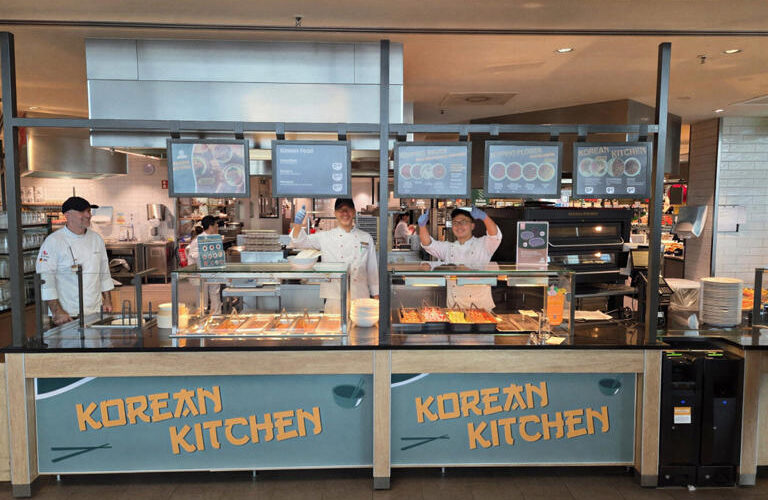
K-food is expanding beyond restaurants and entering Europe’s major retail spaces. A second Korean food court concept store has officially opened inside a hypermarket operated by the German retail giant Globus in Eschborn, a key international business district near Frankfurt.
The new Korean food corner follows the success of the first store launched last year in St. Wendel, a region with almost no Korean residents. Despite the unfamiliar market, the concept received strong feedback from Globus, proving that Korean food can succeed even in areas where K-culture is not yet mainstream. The second store now tests the concept in a very different environment — a global business hub with a high proportion of international customers, including many Asian professionals.
A New Model: “Global Food Consulting” Strategy
The concept behind the store is not a traditional Korean restaurant. Instead, it is based on a “global food consulting” model developed by The Born Korea.
Here’s how it works:
- The Born Korea supplies its proprietary B2B sauces developed in Korea
- Menu design, cooking guides, and operational systems are provided through consulting
- Local German chefs cook the food using locally sourced ingredients
- The result: authentic Korean flavors adapted for the European market
This approach allows Korean food to scale globally much faster than traditional franchise models.
Why Bibimbap Is the Main Menu
The food court focuses on customizable Korean dishes centered around Bibimbap and rice bowls.
Customers can choose:
- Chicken, pork, beef, or vegetarian options
- Different toppings
- Various Korean sauces
This “build-your-own bowl” format matches Western ordering habits already popular in salad bars and poke restaurants. Instead of forcing customers to adapt to Korean dining styles, the concept adjusts Korean food to fit European consumer behavior — one of the key reasons K-food is spreading so quickly worldwide.
More Korean Stores May Follow Across Germany
The second store is only the beginning. Globus and The Born Korea are already discussing a third location. If the concept continues to succeed, the two companies may expand Korean food corners to around 40 Globus hypermarkets across Germany.
That could make Korean food one of the fastest-growing Asian cuisines inside European retail chains — not just in big cities, but also in regional shopping areas.
Why This Matters for Global K-Food Fans
The expansion shows that Korean food is entering a new phase:
- Not just restaurants → now large retail chains
- Not just Korean communities → now mainstream European consumers
- Not just traditional menus → now customizable Korean meals
Just like K-beauty and K-pop, Korean food is evolving into a global lifestyle trend.
Editor’s Comment (KOREA FBI)
K-food is no longer spreading only through Korean restaurants abroad. Now it’s entering Europe’s biggest supermarkets — the same way sushi and poke once did. If this “global food consulting” model succeeds in Germany, Korean food could become a daily meal choice for millions of European consumers. And that would be a huge turning point for the global K-food industry.
작성자 소개