Korean food is no longer just a trend — it’s becoming a national export strategy.
President Lee Jae-myung has vowed strong government support to elevate K-food into a strategic global export industry, riding the momentum of the worldwide K-culture boom. Speaking at a Cabinet meeting held at the Yongsan presidential office in Seoul, Lee emphasized that global interest in Korean cuisine is accelerating alongside the popularity of K-pop, K-dramas, and K-beauty.
“With the global K-culture frenzy, interest in K-food is growing by the day,” President Lee said. “The government will firmly support the boom of Korean food so it can expand beyond the domestic market and become a strategic export industry.”
K-Food Exports Hit Record Highs
The numbers back up the ambition.
According to the Korea Customs Service, Korean food exports reached $10.4 billion through November, marking a 7% increase year-on-year. Officials project that total exports for 2025 will surpass last year’s record of $10.7 billion, setting a new all-time high.
This surge reflects rising global demand for Korean staples such as kimchi, ramen, sauces, rice products, and ready-to-eat meals, driven by international exposure through media, tourism, and social platforms.
From Food to Culture: A Full-Scale Global Strategy
The Cabinet meeting focused not only on exports but on the global expansion of Korean food culture as a whole. President Lee called for comprehensive government measures, including:
- Overseas marketing and branding support
- Improved logistics and supply chains
- Development of food-based tourism products
- Stronger protection of intellectual property rights
He also instructed officials to explore rice exports to Japan, where prices have surged due to a shortage — a move that could turn Korea’s domestic rice surplus into an international opportunity.
Training the Next Generation of K-Food Professionals
Looking ahead, Lee endorsed the idea of establishing chef training schools, including vocational high schools and specialized universities focused on Korean cuisine. The goal: nurture globally competitive culinary professionals who can represent K-food on the world stage.
Prime Minister Kim Min-seok went a step further, proposing the creation of a “UN-style university” that integrates K-food, K-culture, K-pop, and K-beauty, positioning Korea as a global hub for cultural education.
Kimjang Diplomacy: Kimchi as a Cultural Bridge
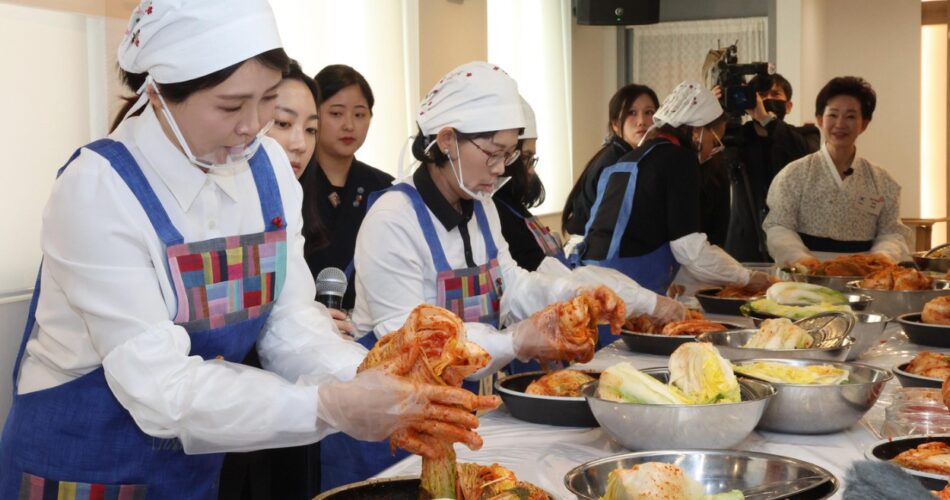
Later the same day, First Lady Kim Hea-kyung hosted a kimchi-making event titled “Harmony of Kimjang: Connecting Cultures Through Kimchi 2025.” The event welcomed spouses of ambassadors from 11 countries, including France, Japan, Canada, Australia, India, and the UK.
Held at Hansik Space E:eum in central Seoul, the event highlighted Kimjang, the traditional practice of making and sharing kimchi for winter — a tradition recognized as a UNESCO Intangible Cultural Heritage.
Participants donned headscarves and gloves, learned traditional techniques from a master kimchi artisan, and later shared a meal featuring freshly made kimchi with rice, boiled pork, tofu, and soybean paste soup.
“Kimjang is a tradition where families and communities come together,” the First Lady said. “Each household has its own ingredients and techniques — and that diversity is what makes it special.”
Beyond Taste: K-Food as Soft Power
President Lee also ordered the Ministry of Foreign Affairs to strengthen coordination among overseas diplomatic missions, ensuring Korean culture and food are promoted more effectively abroad. He stressed that overseas Koreans must feel fully supported and represented, especially those living abroad long-term.
From trade policy to cultural diplomacy, the message was clear: K-food is no longer just about what’s on the plate — it’s about identity, influence, and global connection.
KOREA FBI Editor’s Comment
K-food’s global rise isn’t accidental — it’s the result of culture, storytelling, and authenticity moving together. As kimchi, rice, and Korean flavors travel the world, they carry more than taste; they carry values of community, craftsmanship, and shared culture. The next phase of K-food isn’t just expansion — it’s integration into everyday global life.
SEO Keywords:
K-food, Korean food exports, Kimchi UNESCO, Kimjang culture, K-culture, Korean cuisine global, President Lee Jae-myung, Korean soft power
작성자 소개