K-pop may have opened the door, but in the United States, Korean culture is increasingly becoming a lifestyle.
At KCON LA 2026, held at Crypto.com Arena in Los Angeles, that shift was impossible to miss. As ZEROBASEONE took the stage, thousands of fans sang along to Korean lyrics and filled the arena with cheers.
But outside the concert venue, another side of Korean culture was attracting just as much attention.
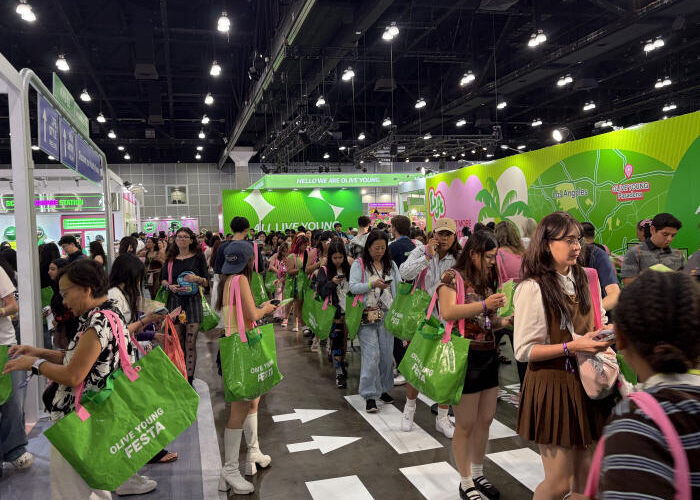
At the Olive Young Festa booth, American consumers lined up to discover Korean cosmetics. At the bibigo pop-up, crowds gathered to taste Korean food. For many visitors, K-pop was simply the starting point.
What they discovered next was an entire Korean lifestyle.
K-Culture Is No Longer Being Consumed in Separate Categories
The biggest change visible at KCON LA was the way international consumers experience Korean culture.
In the past, Korean movies, music, food and beauty often functioned as separate gateways to Korea. Today, those categories increasingly overlap.
A consumer who discovers Korea through K-pop may start trying Korean food. Someone who becomes a fan of a Korean drama may become interested in Korean skincare. A consumer who discovers Korean beauty through social media may eventually become curious about Korean fashion, entertainment and travel.
KCON LA provided a clear snapshot of this crossover.
The event, which began in Irvine, California, with around 10,000 attendees, has grown into a global K-culture festival. Last year’s LA event attracted approximately 125,000 visitors, while cumulative offline attendance from 2012 through 2025 reached 2.35 million.
This year, K-pop was only part of the experience. Visitors could simultaneously explore K-food, K-beauty and other elements of Korean culture.
The bibigo pop-up alone attracted more than 4,000 visitors every day.
Americans Are Experiencing More Than One K-Category
The numbers also show that this is more than a temporary K-pop trend.
According to a CJ Group survey conducted in December 2025 among 7,100 consumers across 12 countries, 75% said they were interested in K-culture, while 53% had actually purchased or experienced Korean products and services.
Both figures increased from the previous year, rising by 6 and 5 percentage points respectively.
The trend is particularly strong in the United States.
About 30% of U.S. consumers surveyed said they had experienced all major K-culture categories, including K-food, K-beauty, K-pop and Korean content. Meanwhile, 75% had experienced at least two categories.
That means Korean culture is increasingly functioning as an interconnected ecosystem rather than a collection of individual trends.
K-Food Is Becoming Part of Everyday Life
The same pattern can be seen in Korean food.
U.S. households consume Korean food an average of 3.38 times per month, higher than the 12-country average of 2.8 times.
And the range of products is expanding.
K-food consumption once centered heavily on instant noodles and dumplings. Now, American consumers are increasingly exploring Korean sauces, pastes and other ingredients that can be incorporated into everyday cooking.
This is an important transition.
Trying Korean food once is cultural curiosity. Buying Korean sauces for the kitchen is something closer to lifestyle adoption.
K-Beauty Is Expanding Beyond Skincare
K-beauty is following a similar path.
Korean skincare remains a major entry point, but consumers are increasingly exploring body care, hair care and makeup. The purchase rate for K-beauty products also increased by 5 percentage points in just one year.
The appeal goes beyond individual products.
For many consumers, Korean beauty represents an entire approach to beauty, from skincare routines and ingredients to makeup techniques and personal care.
That makes K-beauty particularly well suited to social media, where consumers can discover a product, watch a tutorial, share their experience and then purchase it.
Why Offline Spaces Matter
Perhaps one of the most interesting findings is the growing importance of physical spaces.
Social media and online content may spark curiosity, but consumers often need a real-world experience before curiosity becomes purchasing behavior.
Offline stores, TikTok and recommendations from friends were identified as important pathways from interest to actual consumption.
Los Angeles stands out in particular. Compared with cities such as New York, Chicago and Dallas, LA consumers place greater importance on physical spaces where they can experience K-culture.
That makes events such as KCON and Olive Young Festa more than promotional events.
They are cultural bridges.
A consumer can watch a K-pop performance, taste Korean food, discover a Korean beauty product and share the experience on social media—all in the same place.
The Rise of the K-Lifestyle
What I saw in Los Angeles cannot be fully explained simply by saying that “Korean culture is popular.”
Something deeper is happening.
Listening to K-pop, watching Korean dramas, eating Korean food and buying Korean cosmetics are increasingly becoming connected experiences. When those experiences are repeated, they can gradually become part of everyday life.
That is what CJ Group describes as the “normalization of the K-lifestyle.”
The next stage of the Korean Wave may therefore not be about making more people discover Korean culture for the first time.
It may be about turning that first experience into a second purchase, a third experience and eventually a habit.
K-pop opened the door.
K-content brought people inside.
K-food and K-beauty are helping make Korea part of everyday life.
And in Los Angeles, that transformation is already underway.
KOREA FBI Editor’s Comment
The next big K-wave may not be a single product, artist or drama.
It could be the lifestyle itself.
When one K-experience naturally leads to another, Korean culture stops being something people simply watch from afar—and starts becoming something they live.
작성자 소개